What An Essay Really Is?
Key Insight: Writing an essay is not merely transferring thoughts to paper; it's an attempt to discover unexpected and surprising ideas that otherwise won't emerge until you start writing.
When someone mentions "writing an essay" to you, what first comes to your mind? If you're like me, who went through "normal" middle/high school English classes, this following structure naturally shows up in your mind: first, construct a thesis (main argument) in the introduction paragraph; then, continue with supporting body paragraphs (each of which starts with a topic sentence and is followed by supporting evidence); and finally, end it with a conclusion paragraph.
Over a decade of such academic training, we've been taught to think that writing an essay is all about putting your thoughts (things you already learned from the required readings or research) down and defending your argument. But if you trace back to the origin of the essay, which is only about 400 years ago, this way of writing is actually the opposite of what an "essay" was supposed to be.
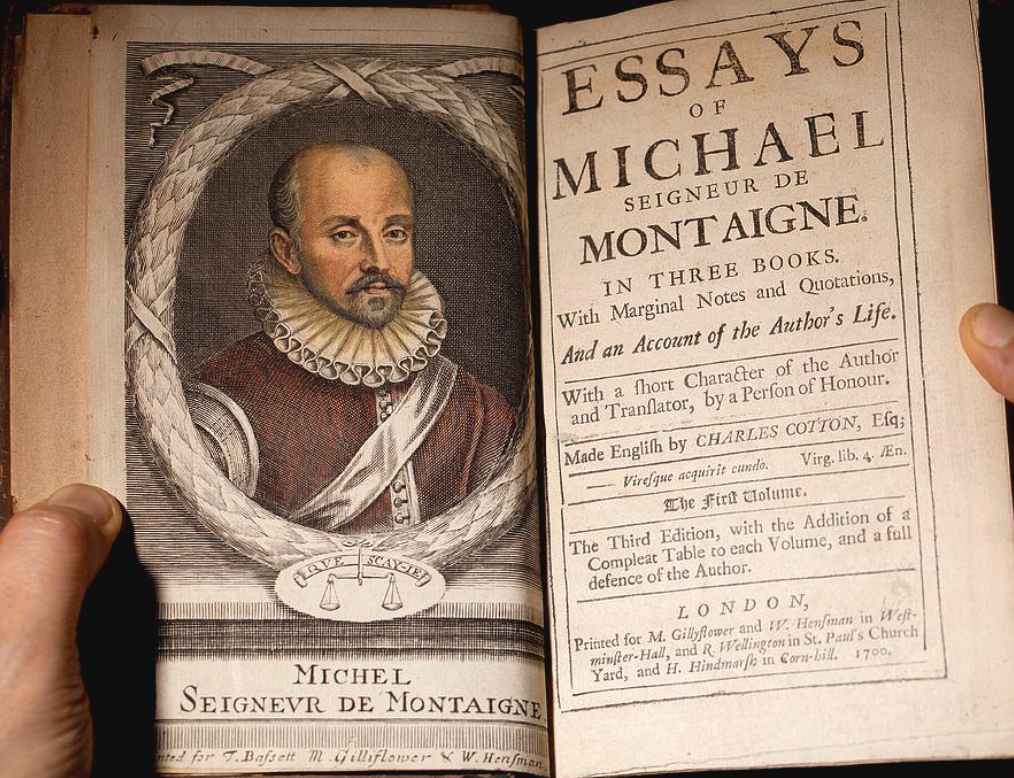
French essayist and philosopher Michel de Montaigne, who lived during the late Renaissance period, is considered the father of the modern essay and was the first person to popularize the essay as a literary genre. Back in 1580, he published a book titled "Essais," which contained a collection of short, personal, informal, and conversational reflections on various topics. The French word "essai" means "attempt", "trial", or "effort". This means:
Writing an essay is not about writing down the things this person had already figured out through thinking and research, but rather, it is an attempt for someone to figure something out as they write. [1]
Writing an essay is not merely a process of converting existing ideas from brain to (online) paper, but a process of discovering.
We write an essay to discover something interesting. Something is interesting if it is surprising. To be surprising, you have to shock someone with an idea that is new, uncommon, and unexpected (sometimes even contradictory to common beliefs). One cannot discover such ideas by writing a typical school essay. Perhaps the most dangerous thing that the teachers taught us to do for a typical school essay is to just take a position and defend it. This not only restricts the freedom of our thoughts and limits our understanding but, more alarmingly, it also keeps us away from exploring new ideas.
So to discover such surprises, one can start with a question that you're deeply curious about. Something that you've been thinking deeply about. But that is not enough. A question has to have answers. How do we know which answer is better than the others? Well, we won't know until we write them out. As we write, more unexpected ideas will emerge themselves. We might or might not end up finding satisfying answers to our original problem. Or we might even switch to a completely new topic as we write. But that's totally fine. That is the natural process of discovery.
This process of real essay writing is actually very similar to the process of scientific discovery and building startups. As a researcher, to publish a paper, you obviously can't say what's been said by previous researchers. The goal of your research is to discover something new, meaning that you are navigating through an unexplored jungle where you don't know what to expect as a result of your attempts. If the results aren't satisfying, you can always adjust your testing methods and continue testing until you find something that validates your hypothesis. Or after many attempts, you might change your hypothesis completely and switch to other directions. This process might take a few years. Or maybe decades. Many groundbreaking scientific discoveries happened this way: Albert Einstein pivoted his research direction when he was working on his Special Theory of Relativity as he realized that the theory didn't account for gravity. This led him to propose that massive objects cause a distortion in space-time that is felt as gravity, which then became the famous Theory of General Relativity.
As a startup founder, your goal is to build something that is new and useful to customers. It's likely that your first few attempts won't directly reach to product-market fit. And that's normal because you're building something that hasn't been built before. Unlike in high school/college, where guidelines and rubrics can guarantee you an A if you meet all the criteria (that's been artificially created by your teacher/professor) for a fake school project, in the real startup world, there are no such guarantees. There are no B+s or C-s for a startup's product. Your product either solves the problem for customers (aka an "A") or it doesn't (aka "fail"). As you're building different product variations, you will discover more customer insights along the way. Sometimes you might even pivot to completely new directions and build completely new startups as you're navigating through this unexplored jungle. In fact, without this trial and pivot process, there wouldn't be unicorn startups like YouTube, Instagram, Slack, Twitch, Shopify, and Twitter.
In essence, writing an essay, conducting scientific research, and building a startup are very similar things — they're nothing but attempts to figure something out. In fact, most of the exciting things in life come from discovering the surprises along the journey of these "attempts". Writing essays turn out to be the most accessible way to discover surprises. And that is a surprise that I didn't discover until I wrote this sentence.
Thanks to Kelvin Mo, Jan Michael Marshall, and Michael Peng for reading drafts of this.
Reference:
[1] Inspired by Paul Graham's essay The Age of the Essay.