Geometry of Grief (Michael Frame)
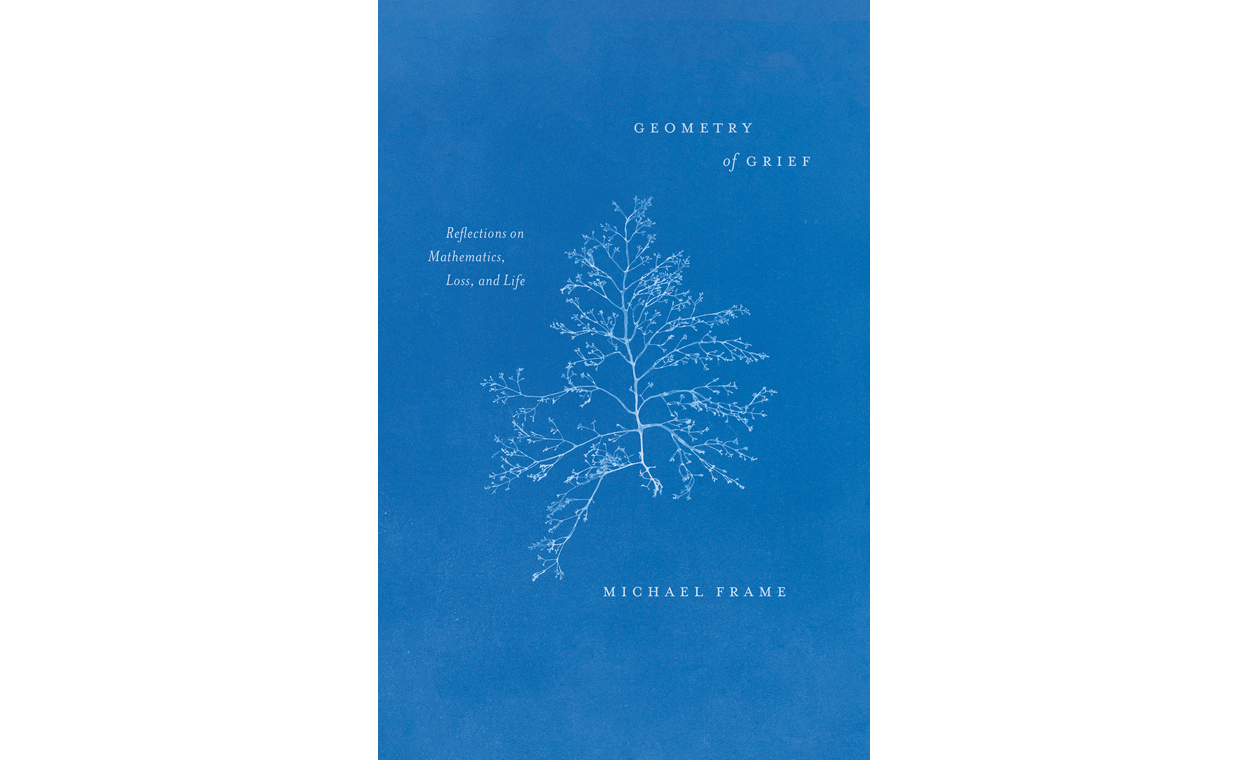
Book in one sentence:
Grief = irreversibility x emotional weight of the loss x transcendence
Structure of this book review:
(Every point in no more than 3 sentences, no extra bullshit.)
Section 1: What does the book say?
Section 2: What I learned from this book?
Section 3: What part of this book can be applied to startups?
Section 1: What does the book say?
Grief is a separation reaction in a circumstance where reunion is impossible.
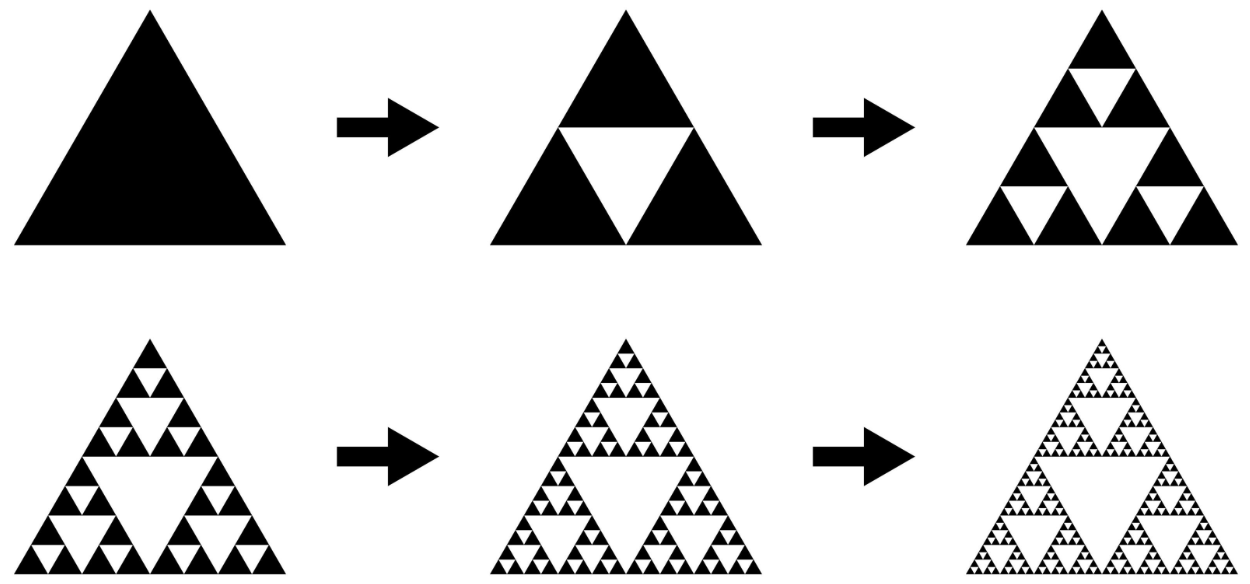
You can apply fractal geometry on reducing the pain and misery of grief: each grief has many subsets, or subgriefs. When we lose a person, we also lose the possibility of new instances of things the person did.
If you can find smaller-scale samples of grief, use those as a laboratory to investigate effective projections. Then use the self-similarity of grief to scale upward. You should discover this self-similarity of grief, a larger grief which consists of smaller-scale samples.
Section 2: What I learned from this book?
"Empathy isn't about knowing how another person feels. Empathy is about how you would feel if you were in the circumstance of another person."
I applied what the author taught us in Chapter 4 of the book about how he himself dealt with the death of his loved ones using geometry on the loss of my grandpa:
"When viewed in story space, grief is signaled by a discontinuity, a jump, a break, in a path. Then if we project in just the right way, the shadows of both pieces of the broken path come close together. That is, in this shadow world, grief has been reduced."
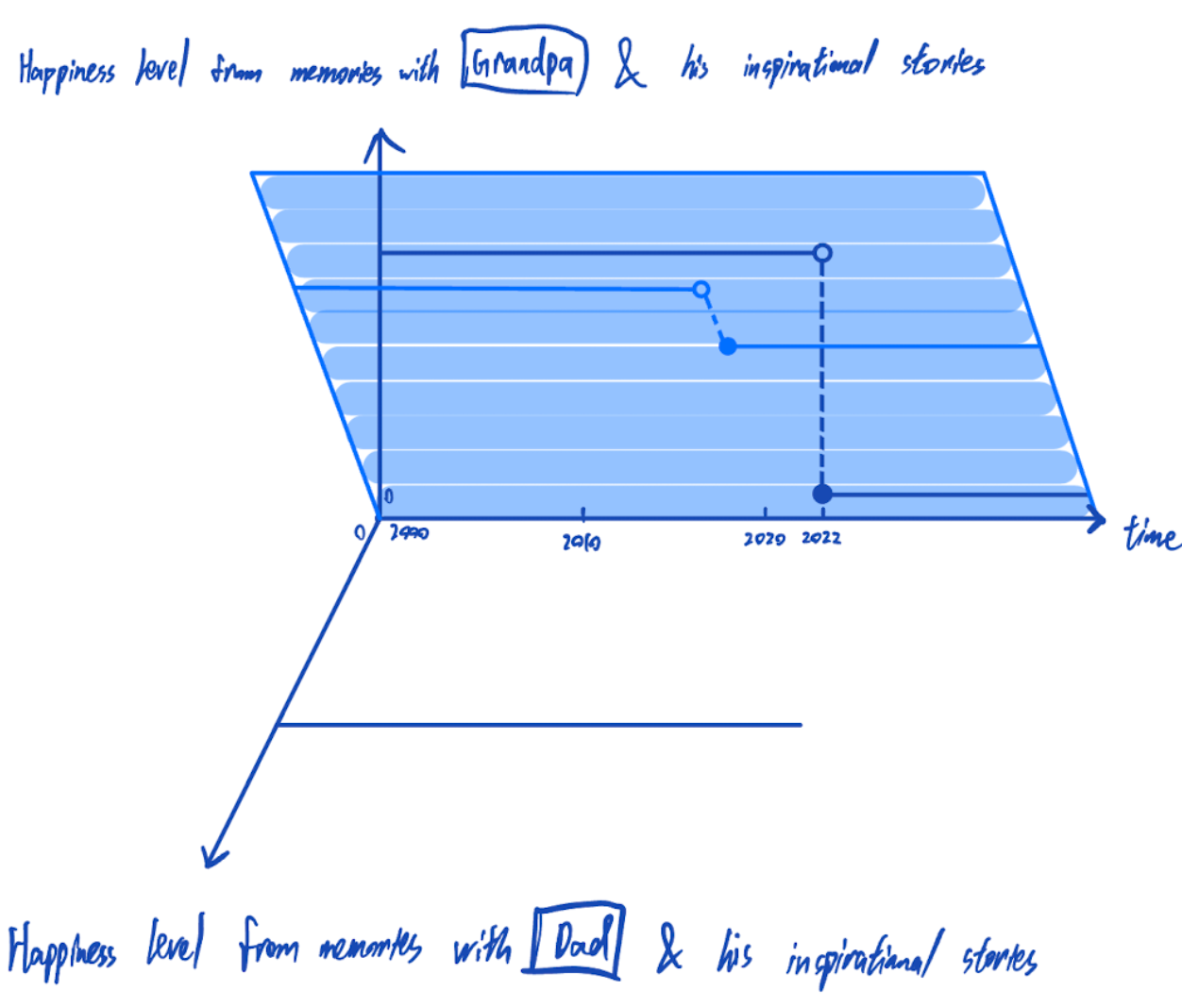
The vertical axis, labeled Happiness level from memories with Grandpa, represents the amount of happiness I felt through spending time with grandpa and learning from his inspirational life stories.
The axis labled Happiness level from memories with Dad, represents the amount of happiness I feel through spending time with dad and learning from his inspirational life stories.
In the subspace of Grandpa axis and time axis, my path has a large discontinuity at the moment my grandpa passed away.
In the subspace of Dad axis and time axis, my path and happiness level remains the same.
The shaded plane is a subspace where I think sometimes about my grandpa and sometimes about my dad. As a result, the drop after grandpa dies is not as large as it was in Grandpa-time subspace.
Please note that spending time and creating new memories with my dad is not a distraction from memories of my grandpa but a reminder of his life, that some versions of his stories/characteristics/behaviors are expressed by my dad.
Section 3: What part of this book can be applied to startups?
A fractal is any geometric pattern that occurs again and again, at different sizes and scales, within the same object. This “self-similarity” can be seen throughout nature, for example in a snowflake’s edge, a river network, the splitting veins in a fern, and the crackling forks of lightning. (Source: https://news.mit.edu/2019/fractal-patterns-quantum-1016)
Peter Thiel's startup philosophy is about avoiding competition as much as one can by achieving monopoly dominance of a specific market. A monopoly, in fact, is made up of many mini-monopolies in smaller-scale markets. (Source: https://youtu.be/yODORwGmHqo)
Combining this startup ideology with fractal geometry, entrepreneurs should aim for dominating a small fractal (market) first, then expand (copy-and-pasting) to dominate other fractals (similar adjacent markets) as quick as possible to become a large fractal (or achieve monopoly).
Final words:
The reason why I bought this book was mainly because my grandpa just passed away this past summer and I didn't know how to react to that (it was my first time going through this kinda stuff). My great friend and colleague, Ivy Wu, also lost someone important in her life recently. I hope this piece can help us both understand grief from a new perspective.
Have you ever lost someone significant in your life? How did you deal with that grief? Please leave some comments below and share your experience with us.